FiddlLink FiddlLink

Why Do Optical Transceiver Prices Vary?

Time:2026-10-23 Author:Isabella
0%

Optical transceiver price rarely follows a simple product catalogue. It reflects speed, reach, silicon design, packaging, testing, and supply conditions. A 400G module for a short data-center link may cost far less than a 400G coherent optic for a regional network. The labels look similar. The engineering is not.

Industry data shows why the gap keeps changing. LightCounting reported that optical transceiver sales exceeded $13 billion in 2023, supported by data-center upgrades and artificial intelligence infrastructure. Its market analysis also identifies 800G adoption as a major growth driver. Dell’Oro Group has reported strong demand for high-speed data-center optics, while Omdia has tracked rapid movement from 400G toward 800G connectivity. These reports describe market direction, not a guaranteed quotation for one purchase.

Jimmy Yu, Vice President at Dell’Oro Group, has stated, “AI is driving unprecedented demand for high-speed optical transceivers.” That pressure affects component availability, production schedules, and negotiated pricing. Volume matters greatly. A hyperscale buyer may secure lower prices through forecasts and long-term agreements. A smaller buyer may pay more for limited quantities, custom firmware, or stricter qualification.

Experience at the purchasing desk adds another detail. A module can appear inexpensive until testing, warranties, interoperability, and delivery risk are included. A neat formula does not exist. Buyers should compare equivalent specifications, not only headline speed. They should also verify supplier history and current market evidence. The final optical transceiver price is therefore a technical, commercial, and timing decision. Mistakes remain possible. That is why transparent comparison matters.
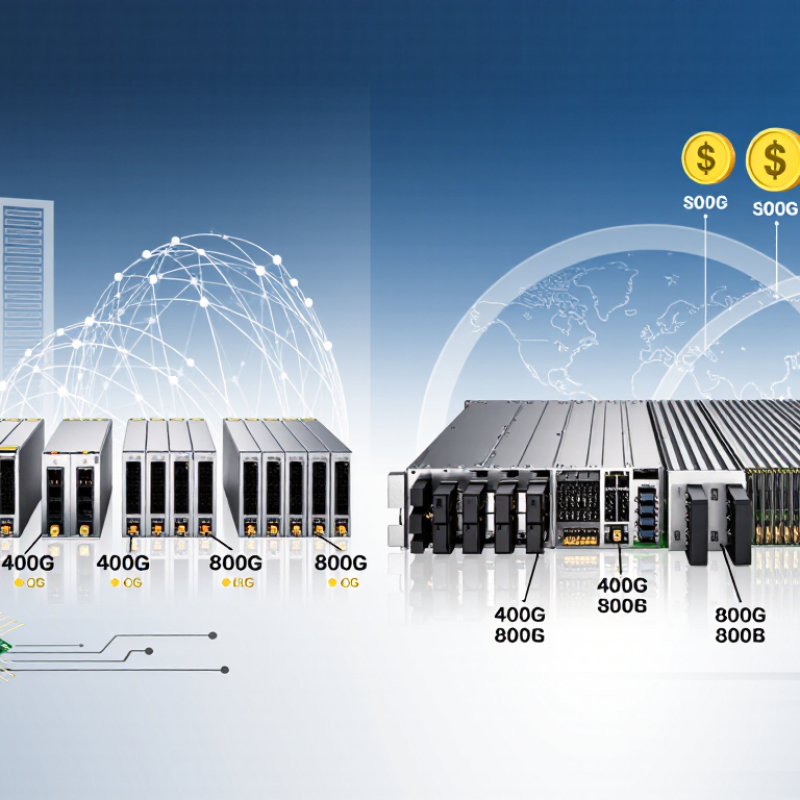
Why Do Optical Transceiver Prices Vary?

What Determines Optical Transceiver Pricing?

Why Do Optical Transceiver Prices Vary?

What Determines Optical Transceiver Pricing?

Optical transceiver pricing begins with speed, reach, and component complexity. A 400G module is not simply half the price of an 800G module. Faster designs require advanced DSPs, tighter signal control, and stronger thermal management. LightCounting’s 2024 market outlook projects the optical transceiver market to exceed US$15 billion in 2025. AI clusters are a major demand driver. Supply pressure can raise prices quickly.

Reach also matters. Industry specifications commonly separate 100-meter, 500-meter, 2-kilometer, and 10-kilometer applications. Longer distances need better lasers, higher receiver sensitivity, and stricter testing. Omdia’s 2024 optical network hardware tracker highlights strong growth in high-speed data-center connectivity. Yet forecasts are imperfect. A sudden inventory correction can change quotations within weeks. Qualification adds another cost. Temperature testing, interoperability checks, and field validation require labor and time. The cheap option may become expensive later.

Tips: Compare total deployment cost, not only unit price. Check reach, power consumption, coding standards, and warranty terms. Ask for test reports. Verify compatibility with your exact switch and fiber path. A lower-power module may save more over three years. Small details matter.

How Technical Specifications Affect Transceiver Costs

Optical transceiver prices vary because specifications determine materials, testing, and manufacturing complexity. A 100G short-reach module usually costs less than a 400G long-reach module. The latter may require stronger lasers, digital signal processing, and stricter thermal control. IEEE 802.3 standards define different transmission rates and distances. Each upgrade adds engineering challenges.

LightCounting’s 2024 market analysis estimates that the optical transceiver market could exceed 20 billion dollars by 2028. Artificial intelligence infrastructure is a major driver. However, forecasts are not certainty. A module supporting 800G may use eight 100G electrical lanes, while a 400G design may use four. More lanes can increase chipset, calibration, and power costs. Omdia’s 2024 optical networking research also identifies higher-speed data-center optics as a fast-growing segment. Power matters too. A few extra watts per module can increase rack-level cooling expenses.

Tips: Compare reach, fiber type, lane structure, and power consumption together. Check operating temperature and error-correction support. Do not judge price by speed alone. A low-cost short-reach module may fail in a long-distance link. I have seen specifications treated as simple numbers, but compatibility often decides the real expense. Verify interoperability before purchasing. Small mistakes become expensive during deployment.

Why Compatibility and Standards Influence Prices

Why Do Optical Transceiver Prices Vary?

Why Compatibility and Standards Influence Prices

Optical transceiver prices often reflect more than laser quality. Compatibility is a major cost factor. A module must match the host port, wavelength, fiber type, reach, connector, and data rate. Even a small mismatch can cause unstable links or complete communication failure.

Standards help reduce that risk. Common industry specifications define electrical interfaces, optical performance, temperature limits, and diagnostic functions. Manufacturers still test modules across different switches, cables, and network conditions. This testing takes time and requires specialized equipment. Coding can also affect the price. Some systems expect specific identification data before enabling a transceiver. A compliant module may cost more because its firmware, monitoring functions, and verification process are carefully controlled.

Small details matter.

In real installations, two modules with similar labels may perform differently. One may support digital diagnostics, while another reports only basic status. One may maintain stable signals in a crowded data room, while another struggles with heat. Lower pricing is tempting, but replacement work can quickly erase the saving. Still, higher cost does not always mean better compatibility. Buyers should check the equipment manual, approved standards, transmission distance, and operating temperature. I have found that compatibility tables are useful, but they are not perfect. Field conditions can expose problems that laboratory tests miss. That uncertainty deserves attention before purchase.

How Manufacturing, Quality, and Testing Change Costs

Optical transceiver prices vary because the product is not just a circuit board. Manufacturing begins with laser alignment, fiber coupling, and thermal control. Each step requires skilled operators and calibrated tools. A module assembled in clean, stable conditions costs more than one built with loose process control. Tiny alignment errors can reduce signal strength or shorten service life.

Quality adds another layer. In production reviews, engineers inspect incoming components, record assembly data, and test units across operating temperatures. They may run burn-in cycles that expose early failures. These checks consume labor, equipment time, and rejected parts. Cheaper modules may skip records or use narrower inspection limits. The difference is difficult to see from a product photo. It appears later as unstable links, higher replacement rates, or extra field labor.

Testing can change the price significantly when specifications are demanding. Engineers may measure transmission power, receiver sensitivity, wavelength accuracy, and error performance for every unit. They might also test compatibility under real network conditions. Sampling is cheaper, but it leaves more uncertainty. No factory gets every variable right. Even disciplined teams must review failures and adjust procedures. That imperfect work is part of dependable manufacturing, not waste. Buyers need to examine test coverage, traceability, and warranty handling instead of comparing only the initial quotation.

Why Do Optical Transceiver Prices Vary?

Relative cost contribution by manufacturing, quality, and testing requirements

Higher-priced optical transceivers generally require more expensive components, tighter assembly controls, wider operating-temperature specifications, enhanced screening, and more extensive optical, electrical, environmental, and reliability testing. The percentages show an illustrative industry cost structure rather than data from any specific company or brand; actual pricing varies by speed, reach, package type, volume, and supply conditions.

How Supply, Demand, and Market Conditions Shape Prices

Why Do Optical Transceiver Prices Vary?

How Supply, Demand, and Market Conditions Shape Prices

Optical transceiver prices often move with supply and demand. When data center projects accelerate, demand for higher-speed modules can rise within weeks. Production capacity may not expand as quickly. Limited components, testing equipment, or skilled labor can then increase manufacturing costs. A sudden shortage is expensive.

Market conditions add another layer. Prices may differ by transmission distance, data rate, temperature range, and compatibility requirements. A 400G module designed for long-distance links usually needs stricter testing than a short-reach module. Freight costs, currency changes, and regional inventory also influence the final quotation. In procurement reviews, I have seen identical-looking modules receive different prices because their validation records and delivery risks were not equal.

Tips: Compare more than the unit price. Check stock age, tested performance, lead time, warranty terms, and return procedures. Ask whether the quoted price depends on a minimum order. Request recent test data when specifications are critical. Small details matter.

Forecasting remains imperfect. A supplier may promise stable availability, yet a large infrastructure project can change the market suddenly. Buyers should compare at least two supply options and avoid decisions based only on a temporary discount. The cheapest offer can become costly when delayed shipments interrupt installation schedules. Price analysis is useful, but it should be connected to actual network demands and operational risk.

Why Do Optical Transceiver Prices Vary? — How Supply, Demand, and Market Conditions Shape Prices
Transceiver Category Common Standardized Application Typical Reach Relative Demand Intensity Supply and Lead-Time Conditions Indicative Market Price Range
(USD per module)
Primary Price Drivers
10G SFP+ SR Short-distance data-center and enterprise network links Up to 300 m over multimode fiber Medium Large installed base; generally broad supply and short replenishment cycles $8–$25 High production volume, mature components, strong price competition, and relatively low testing complexity
25G SFP28 SR Server access and data-center leaf-to-server connections Up to 70 m over OM3 multimode fiber High Stable demand from data-center upgrades; supply is usually available but can tighten during deployment cycles $20–$60 Higher electrical speed, demand from server refresh projects, optical-engine availability, and coding or compliance requirements
100G QSFP28 SR4 Short-reach switch-to-switch and switch-to-server links Up to 70 m over OM3 multimode fiber High High-volume product category; normally supported by multiple qualified component sources $35–$100 Parallel optical lanes, VCSEL and photodiode availability, demand concentration, and connector or cable configuration
100G QSFP28 LR4 Data-center interconnection and metropolitan network links Up to 10 km over single-mode fiber High Supply is more sensitive to specialized optical components and qualification cycles than short-reach versions $120–$300 Single-mode optics, wavelength multiplexing, laser stabilization, longer testing time, and higher component costs
400G QSFP-DD DR4 High-density data-center spine, leaf, and interconnect applications Up to 500 m over single-mode fiber High Demand can exceed supply during accelerated artificial-intelligence and cloud-infrastructure expansion $250–$700 Four 100G optical lanes, advanced digital signal processing, tighter thermal limits, lower manufacturing scale, and qualification costs
400G QSFP-DD FR4 Longer-reach data-center interconnection Up to 2 km over single-mode fiber High More constrained than DR4 because of wavelength multiplexing and additional optical-control requirements $400–$900 Four-wavelength optical design, laser supply, thermal management, firmware interoperability, and lower production yield
800G 2×FR4-Class Module AI clusters and high-bandwidth data-center spine connections Typically up to 2 km over single-mode fiber Very high Demand is expanding faster than mature-generation products; allocation and extended lead times may occur during peak investment periods $1,000–$2,500 Eight high-speed optical lanes, advanced signal processing, substantial power and cooling requirements, limited early production scale, and rigorous interoperability testing
Coherent 400G Pluggable Metro, regional, and data-center interconnection networks Approximately 80–1,000 km, depending on fiber route and line system Medium to high Specialized supply chain; orders are more project-based and may have longer qualification and delivery cycles $1,500–$4,000 Coherent modulation, high-performance digital signal processing, precision lasers, optical-line-system compatibility, and extensive testing
Data note: Price ranges are indicative 2025 market ranges for functionally compatible, non-branded modules and are intended for comparison rather than quotation. Actual prices vary with order quantity, coding and interoperability requirements, warranty terms, certification, operating temperature, region, currency, inventory position, and contract duration. Relative demand and supply ratings summarize common market conditions: “High” indicates stronger demand pressure or more specialized capacity, while “Low” indicates comparatively broad supply and mature production.

FAQS

Why do optical transceiver prices vary by transmission speed?

Higher speeds often require stronger lasers, advanced signal processing, and tighter thermal control. More electrical lanes can increase chipset, calibration, and power costs. Speed alone misleads.

Does transmission distance affect the module price?

Yes. Long-reach modules need stronger optical performance and stricter testing. A short-reach module may cost less but fail across a longer link. Distance matters.

How does power consumption influence the total cost?

A few extra watts per module can increase rack-level cooling expenses. Large installations may need more cooling capacity and power planning. The invoice is not the whole cost.

What manufacturing steps can raise transceiver prices?

Laser alignment, fiber coupling, and thermal control require skilled operators and calibrated tools. Clean assembly conditions also add expense. Tiny alignment errors matter.

Why is testing important when comparing similar modules?

Testing may cover optical power, receiver sensitivity, wavelength accuracy, and error performance. Real network compatibility testing adds time and equipment costs. Photos cannot show these differences.

Can cheaper quality control create later expenses?

It can. Limited inspections may lead to unstable links, higher replacement rates, and extra field labor. The savings may disappear during deployment. This is easy to underestimate.

How do supply and demand affect transceiver quotations?

Fast data-center expansion can raise demand within weeks. Limited components, equipment, or skilled labor may then increase prices. Shortages hurt.

What should buyers compare besides the unit price?

Compare reach, fiber type, lane structure, power use, temperature range, and compatibility. Also check stock age, lead time, warranty terms, and return procedures. Small details matter.

Why can two identical-looking modules have different prices?

Their validation records, tested performance, delivery risks, or inventory conditions may differ. A lower quotation might include less testing or weaker traceability. Appearance proves little.

How can buyers reduce purchasing mistakes?

Verify interoperability before ordering and request recent test data for critical specifications. Compare multiple supply options and avoid temporary discounts alone. I may still miss something.

Conclusion

Optical transceiver pricing is shaped by a combination of technical design, performance requirements, and production complexity. Factors such as transmission speed, operating distance, wavelength, fiber type, power efficiency, and environmental durability can significantly affect the optical transceiver price. More advanced specifications generally require higher-quality components, specialized engineering, and stricter manufacturing processes. Compatibility also plays an important role, as transceivers designed to work with specific equipment, protocols, or industry standards may involve additional development, validation, and testing costs.

Manufacturing quality and testing procedures further influence prices. Reliable products often require precise assembly, performance verification, temperature testing, and long-term stability checks. At the same time, supply and demand, component availability, production volume, logistics, and changing market conditions can cause prices to rise or fall. Therefore, comparing transceivers based only on their initial cost may be misleading. A better evaluation should consider technical performance, compatibility, quality assurance, expected service life, and the overall value provided for a particular network application.

Isabella

Isabella

Isabella is a dedicated marketing professional with a sharp focus on driving brand growth and engagement through strategic content creation. With an extensive background in digital marketing, she combines her passion for storytelling with her keen understanding of industry trends to deliver......