 FiddlLink
China’s 100G QSFP28 module market has become a practical choice for data centers, telecom networks, and high-capacity enterprise links. This guide examines ten leading Chinese suppliers through technical capability, production experience, testing discipline, and customer support. The focus is not only on catalog claims. It also considers optical performance, interoperability, delivery consistency, and field reliability.
A 100G QSFP28 module must handle demanding conditions. Engineers inspect four-lane 25Gbps signaling, transmission distance, power consumption, connector quality, and temperature stability. A module may look competitive on paper, yet perform differently inside a crowded rack. Peter Winzer, a respected optical communications expert, describes the field this way: “Optical communications is the nervous system of the Internet.” His point remains useful here. Reliable optical components support every layer above them.
The suppliers in this list are not ranked by marketing visibility alone. Their product portfolios, manufacturing depth, quality controls, and international service capacity also matter. Some companies specialize in short-range multimode links. Others focus on single-mode 100G LR4, CWDM4, or extended-temperature applications. Those differences are easy to overlook.
There is no perfect supplier for every network. Buyer requirements vary.
Price can also mislead. A lower quotation may involve limited testing, longer qualification work, or weaker after-sales support. Public company information is sometimes incomplete, and supplier capabilities can change quickly. Therefore, this overview should support technical due diligence, not replace it. Request current datasheets, test reports, compatibility records, and sample units before making a final purchasing decision.
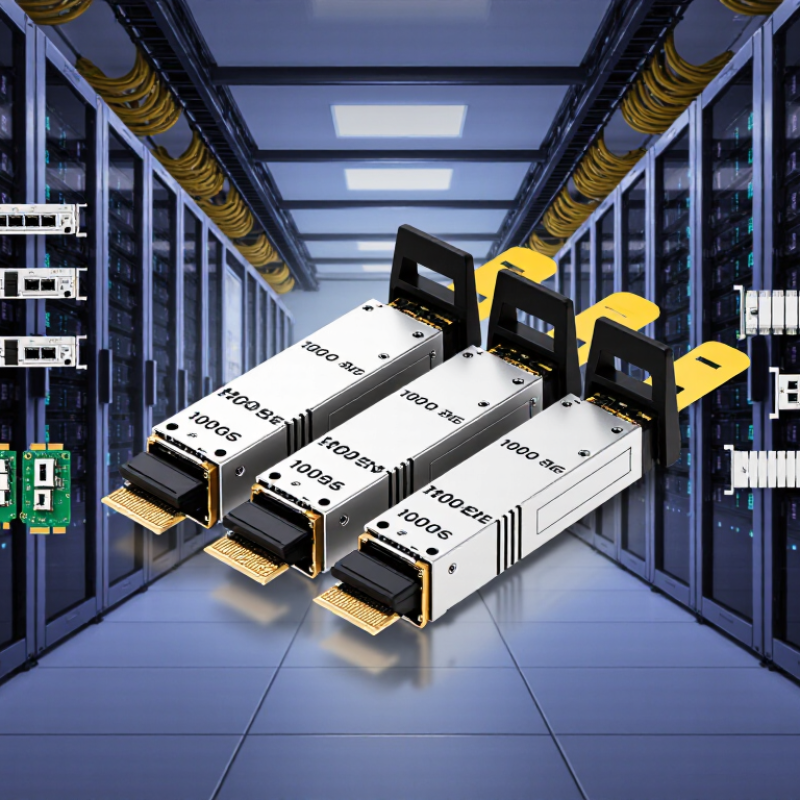
100G QSFP28 Modules: Definition, Standards, and Main Applications
A 100G QSFP28 module is a compact optical transceiver for high-speed network links. It usually carries 100Gbps through four 25Gbps electrical lanes. The module connects switches, routers, servers, or storage systems inside data centers. Its small form factor also supports dense rack designs.
Common specifications include the QSFP28 MSA and IEEE 802.3ba standards. Different optical versions support short, medium, or longer transmission distances. Some use parallel multimode fiber with MPO connectors. Others use duplex single-mode fiber with LC connectors. Selection must match fiber type, distance, wavelength, and equipment coding. In real installations, a mismatch can cause unstable links, even when the labels appear correct. That detail is easy to underestimate.
Tips: Confirm DOM readings, connector polarity, and firmware compatibility before deployment. Test every link with a calibrated optical meter. Keep insertion loss records. These records help during troubleshooting. Main applications include data center spine-leaf connections, server aggregation, cloud infrastructure, and telecom transport networks. Power consumption and thermal performance also matter in crowded cabinets. Lower power is useful, but it may not guarantee better stability. No selection is perfect. Engineers should review actual traffic patterns, maintenance skills, and future upgrade plans instead of choosing only by price.
| Module Type | Definition and Optical Interface | Relevant Standard or MSA | Transmission Medium | Typical Reach | Wavelength / Lane Configuration | Connector | Main Applications |
|---|---|---|---|---|---|---|---|
| 100GBASE-SR4 | Short-reach parallel optical module for four independent 25 Gb/s lanes. | IEEE 802.3bm; QSFP28 MSA | Multimode fiber, normally OM3 or OM4 | Up to 70 m on OM3; up to 100 m on OM4 | 850 nm; 4 × 25.78 Gb/s NRZ | MPO-12 or equivalent multifiber connector | Data-center leaf–spine links, server aggregation, and short rack-to-rack connections |
| 100GBASE-SRBD | Bi-directional short-reach module using two optical wavelengths over two multimode-fiber pairs. | IEEE 802.3bm; QSFP28 MSA | Multimode fiber, typically OM3 or OM4 | Up to 70 m on OM3; up to 100 m on OM4 | Approximately 832 nm and 918 nm; bidirectional 2 × 50 Gb/s optical paths | Duplex LC | High-density data-center links where duplex LC cabling is preferred |
| 100G PSM4 | Parallel single-mode module with four independent 25 Gb/s optical lanes. | PSM4 MSA; QSFP28 MSA | Single-mode fiber | Up to 2 km | 1310 nm; 4 × 25.78 Gb/s NRZ | MPO-12 or equivalent multifiber connector | Data-center interconnects and campus links requiring longer reach than multimode optics |
| 100G CWDM4 | Coarse-WDM module that multiplexes four 25 Gb/s lanes onto one duplex single-mode-fiber pair. | CWDM4 MSA; QSFP28 MSA | Single-mode fiber | Up to 2 km | Four CWDM wavelengths near 1271, 1291, 1311, and 1331 nm; 4 × 25.78 Gb/s NRZ | Duplex LC | Switch-to-switch connections, structured cabling, and short data-center interconnects |
| 100GBASE-DR | Single-lambda, single-mode module designed for one 100 Gb/s optical channel. | IEEE 802.3cu; QSFP28 MSA | Single-mode fiber | Up to 500 m | 1310 nm; 100G PAM4 electrical and optical signaling | Duplex LC | High-density data-center fabrics and short single-mode links |
| 100GBASE-FR1 | Single-lambda 100G module optimized for moderate-reach single-mode transmission. | IEEE 802.3cu; QSFP28 MSA | Single-mode fiber | Up to 2 km | 1310 nm; 100G PAM4 | Duplex LC | Data-center interconnects, metropolitan access, and enterprise backbone links |
| 100GBASE-LR1 | Single-lambda long-reach module for standard single-mode-fiber infrastructure. | IEEE 802.3cu; QSFP28 MSA | Single-mode fiber | Up to 10 km | 1310 nm; 100G PAM4 | Duplex LC | Metro data-center interconnects, carrier networks, and enterprise WAN access |
| 100GBASE-LR4 | Long-reach wavelength-division multiplexed module carrying four 25 Gb/s lanes over one fiber pair. | IEEE 802.3ba; QSFP28 MSA | Single-mode fiber | Up to 10 km | Four LAN-WDM wavelengths around 1310 nm; 4 × 25.78 Gb/s NRZ | Duplex LC | Data-center interconnects, metropolitan networks, and high-capacity enterprise links |
| 100GBASE-ER4 | Extended-reach WDM module using four optical lanes for longer single-mode-fiber links. | IEEE 802.3ba; QSFP28 MSA | Single-mode fiber | Up to 40 km | Four LAN-WDM wavelengths near 1310 nm; 4 × 25.78 Gb/s NRZ | Duplex LC | Regional data-center interconnects, metropolitan networks, and service-provider transport |
| 100G ER4L | Extended-reach 100G WDM module designed for applications between standard LR4 and ER4 distances. | 100G ER4L MSA; QSFP28 MSA | Single-mode fiber | Typically up to 25 km, depending on link budget and deployment conditions | Four LAN-WDM wavelengths around 1310 nm; 4 × 25.78 Gb/s NRZ | Duplex LC | Metro data-center interconnects and regional network aggregation |
SR4 usually supports multimode-fiber links up to 100 meters. Dust can reduce that distance.
LR4 can reach about 10 kilometers over single-mode fiber. Fiber quality still matters.
Check port coding, firmware needs, and forward error correction settings. Confirm the connector and fiber type.
Request a written compatibility list for your exact model. Ask for EEPROM data and DOM readings.
Request optical power, temperature, error counters, eye diagrams, and traffic stability results. Photos are not enough.
Not automatically. Lower prices may hide higher replacement labor or weaker long-term stability.
Chipset, warranty, fiber type, testing depth, and order volume can change the price. Compare total ownership cost.
Test it for several days under real traffic. Record link uptime, temperature, optical power, and errors.
Certification supports controlled production, but it does not replace product-level testing. My comparison method is imperfect.
Confirm warranty terms, replacement procedures, support hours, export documents, and sealed packaging. Small details matter.
This article provides a practical overview of the 100G QSFP28 module, explaining its basic structure, transmission standards, optical interfaces, and common applications in data centers, enterprise networks, cloud computing, and telecommunications. It also introduces a clear method for evaluating China’s leading suppliers, focusing on product quality, technical capability, manufacturing capacity, certification, delivery reliability, customer support, and industry experience rather than brand popularity alone.
Readers will also find a comparison of supplier performance, device compatibility, transmission distance, power consumption, customization options, and pricing considerations. The final section offers useful guidance for selecting a reliable Chinese supplier, including how to verify specifications, test interoperability, review quality-control procedures, assess warranty policies, and communicate technical requirements. By following these criteria, buyers can reduce procurement risks and choose a 100G QSFP28 module that delivers stable performance, dependable compatibility, and suitable long-term value for their network infrastructure.
